HERAT, Afghanistan — Afghanistan’s already fragile economy is increasingly being tested by its ability to absorb a large wave of returnees from neighboring Iran, placing renewed attention on the country’s private sector as a potential stabilizing force amid deep structural unemployment and chronic outward migration.
The pressure intensified after Iranian authorities accelerated the forced repatriation of undocumented Afghans, triggering one of the region’s largest recent migration reversals. According to Ahmadullah Muttaqi, head of the Herat Directorate of Information and Culture, more than 1.057 million Afghan migrants entered the country through the Islam Qala border crossing in Herat during the peak of the deportation campaign. At its height, daily arrivals surged to nearly 35,000 people, placing severe strain on border facilities and local labor markets.
By May 2026, however, the pace of deportations had slowed markedly. Despite renewed geopolitical tensions and military signaling between Washington and Tehran, cross-border returns have fallen to several hundred individuals per day, easing immediate humanitarian pressures along the frontier.
Yet the economic drivers behind Afghan migration remain fundamentally unchanged. For many returnees, the absence of sustainable employment continues to outweigh security or political considerations, reinforcing migration as an economic necessity rather than a purely geopolitical phenomenon.

Migration Shock and Labor Market Pressures
Against this backdrop, Herat’s industrial sector has emerged as one of the few functioning absorbers of labor displacement. In the absence of large-scale state welfare mechanisms or broad public-sector hiring, the Herat Industrial City has become a critical economic shock absorber for western Afghanistan.
The industrial zone, which hosts roughly 1,350 manufacturing enterprises, is estimated to employ around 150,000 workers, although labor demand fluctuates seasonally and remains vulnerable to shifts in domestic consumption and regional trade conditions.
Data from the Herat Chamber of Industries and Mines indicate that approximately 6,000 deported migrants have already been integrated into industrial employment — a rare example of private-sector labor absorption at a time when much of Afghanistan’s economy remains constrained by liquidity shortages, weak investment flows, and limited banking access.
Private Industry as an Economic Buffer
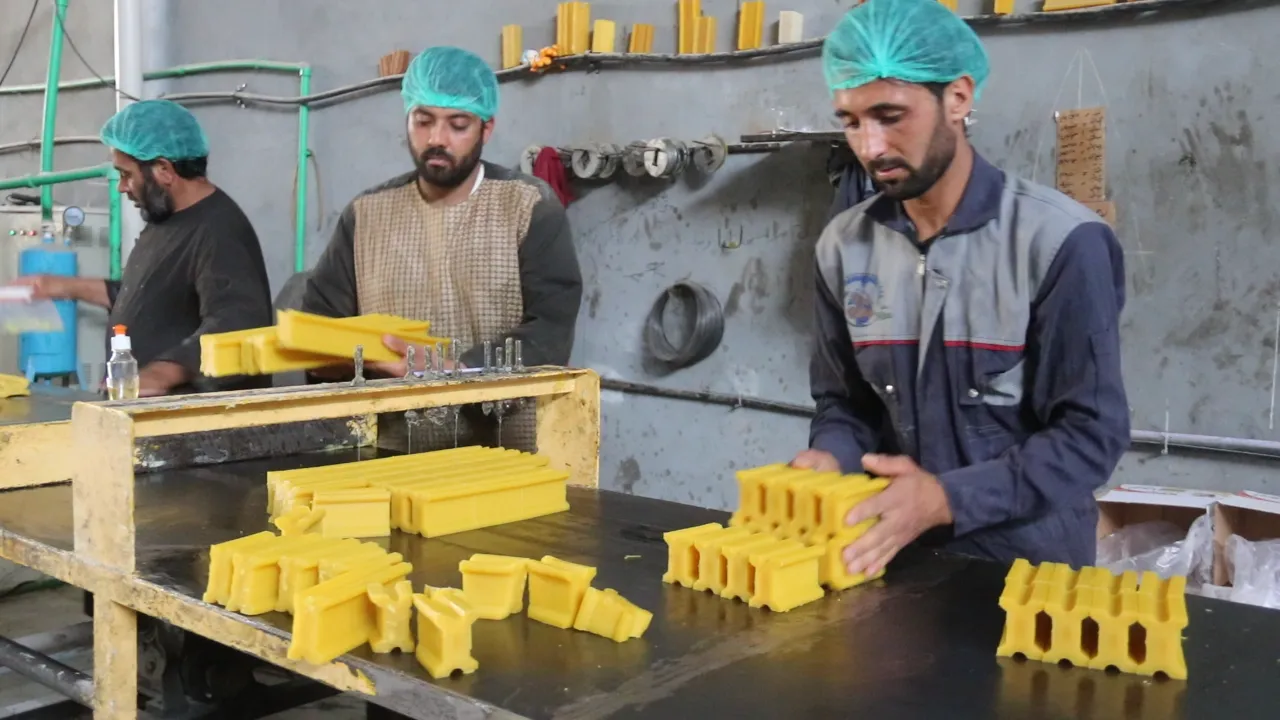
One example is the Nazari detergent and soap manufacturing company, established roughly a year ago with an initial investment of about $300,000. The factory currently produces nearly 30,000 bars of soap per day, in addition to two to three metric tons of liquid detergents and shampoo products.
A notable share of its workforce consists of Afghans recently expelled from Iran.
“Our expansion is directly linked to our ability to create immediate employment for returnees who have lost their livelihoods across the border,” Safiullah Nazari, the company’s managing director, told Khate-Nakhost.

Tariff Protection and Import Substitution
The sustainability of such enterprises, however, remains closely tied to the Taliban administration’s trade and tariff regime. According to Nazari, higher import duties on competing foreign consumer goods have reduced the volume of imported products entering domestic markets, creating space for local manufacturers to increase market penetration through import substitution.
At the same time, the sector remains heavily dependent on imported raw materials — particularly from Iran — exposing Afghan manufacturers to foreign exchange volatility, supply-chain disruptions, and political risk tied to cross-border trade.
Informal Markets and Regulatory Weakness
Formal manufacturers also face mounting pressure from unregulated cottage industries operating on the outskirts of Herat. These small-scale producers often bypass taxation, licensing requirements, and quality-control standards, allowing them to undercut registered factories with cheaper but lower-grade products.
Industrialists argue that the expansion of the informal sector is distorting market competition and eroding incentives for long-term industrial investment at a time when Afghanistan urgently needs productive capital formation.
Can Afghanistan Build a Self-Sustaining Industrial Base?
For Herat’s manufacturers, the challenge is no longer solely about production capacity. It is increasingly about whether Afghanistan can build a sufficiently resilient domestic economy capable of absorbing displaced labor, reducing migration dependency, and transitioning from humanitarian reliance toward a more self-sustaining industrial base.